Casanova’s Chocolate

“A furtive footstep travels along the deserted alley. A cat of indistinguishable color, balanced on a slender ledge, pauses to scrutinize the young man who walks, nonchalant and silent, wrapped in a brown cloak. A light breeze blows, carrying the fragrances of the night, laden with allurements, like excessive (irrepressible) caresses: the briny scent of the lagoon, the sweet and languid fading of the wisteria, the oriental call of cinnamon and cardamom that still lingers in the old dusty warehouses (recalling a glory now in its twilight). And finally another, faint perfume, inviting and refined, which becomes ever more intense, as Giacomo easily scales a wall and penetrates into the darkness of a small garden, beneath the protective branches of a linden tree. The dim glow of a shaded lantern illuminates the frame of an open window, on the first floor. Up there a lady (madam, gentlewoman) with jade-colored eyes watches the waning moon and slowly sips chocolate from a fine majolica cup, the exquisite nectar that comes from the West Indies. Giacomo advances into the circle of light. A flash of surprise flickers in the lady’s eyes… but it is a moment, only a moment. And then a knowing smile. The woman disappears, but a door in the shadows opens, a silent invitation…”
Between the seventeenth and eighteenth centuries, Venice’s commercial role is in full decline, but the city still represents in the European imagination one of the capitals of etiquette and good taste, albeit with its countless contradictions that only a land rising from the waters can possess.


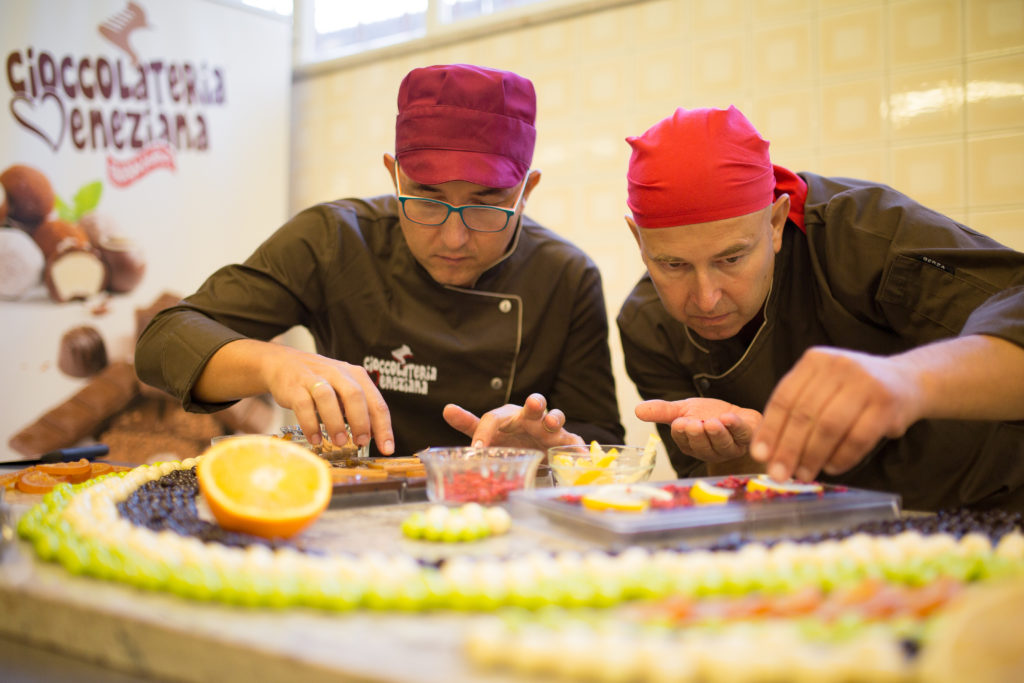
And so, in the enchanted place where one of the most famous Carnivals in the world rages, when man forgets time and deceives death with masks and costumes, the beverage obtained from cacao seeds cannot be missing, which Carl Linnaeus promptly named “theobroma cacao”, that is, “food of the gods”. High society frequents the “chocolate houses”, venues dedicated to tasting, but also to meetings and debates, according to the Enlightenment perspective: Carlo Goldoni also reminds us of this, in his playful drama La conversazione, when the merry company of noble friends loudly declares: “Long live chocolate and the one who invented it“. The chocolate produced today, following the original recipe, is the offspring of that tradition, and jealously preserves its secrets, the fruit of the experience of a pastry-making craft that has been able to blend the flavor of oriental spices and the intense aroma of Central American cacao. We await you. Francesco & Simone Mengo


Prima volta qui?

5% SCONTO

sul tuo primo ordine

*Termini e condizioni applicati

OFFERTA DI BENVENUTO